
Multi-station home gyms offer the convenience of a full gym in a compact footprint, letting you perform dozens of exercises without monthly membership fees or crowded equipment. This comprehensive guide explores the best multi-station home gyms available, from budget-friendly options to premium systems designed for serious lifters.
Quick Comparison Table
Product | Weight Stack | Exercise Capacity | Footprint | Price Range | Best For |
Marcy MWM 990 | 150 lbs | 30+ exercises | 68 in x 42 in x 78 in | $400 to $500 | Best Overall Value |
Bowflex Xtreme 2SE | 210 lbs Power Rod | 70+ exercises | 49 in x 81 in x 62 in | $1,500 to $1,800 | Best No Cable Change Design |
Total Gym XLS | Bodyweight | 80+ exercises | 19 in x 90 in x 43 in | $1,200 to $1,500 | Best for Functional Training |
BalanceFrom RS 80 | 125 lbs | 50+ exercises | 80.5 in x 48 in x 30 in | $500 to $700 | Best Budget Multi Station |
Bowflex PR1000 | 210 lbs (Power Rod) | 30+ exercises | 82 in x 38 in x 82 in | $600 to $800 | Best with Rowing Station |
Body Solid G1S | 160 lbs | 40+ exercises | 49 in x 36 in x 83 in | $1,400 to $1,700 | Best Premium Quality |
Weider 2980 X | 80 lbs (214 lbs resistance) | 40+ exercises | 82 in x 41 in x 82 in | $600 to $800 | Best Pulley System |
Sportsroyals 154 LBS | 154 lbs | 50+ exercises | 69 in x 41 in x 80 in | $500 to $700 | Best Commercial Grade Steel |
Mikolo Home Gym | 150 lbs | 30+ exercises | 75 in x 45 in x 82 in | $450 to $600 | Best Modern Design |
Fitness Reality Power Cage | 800 lb capacity | 24+ exercises with attachments | 53 in x 51 in x 82 in | $400 to $600 | Best Power Rack System |
Detailed Product Reviews
Marcy 150-lb Multifunctional Home Gym Station (MWM-990)
Price: $400-$500

The Marcy MWM-990 delivers exceptional value, offering over 30 strength-training exercises in a compact, affordable package.
Specifications:
- Weight Stack: 150 lbs selectorized vinyl-coated stack
- Stations: Dual-action press arms, high/low pulley, leg developer, preacher curl pad
- Dimensions: 68″ L x 42″ W x 78″ H
- Weight Capacity: User capacity not specified by manufacturer
- Frame: Heavy-duty steel tubing with guard rods
Pros:
- Excellent value for money (under $500)
- 150 lb weight stack suitable for beginners to intermediate users
- Dual-action press arms for chest press and butterfly exercises
- Removable and adjustable preacher curl pad
- High-density boxed upholstery on seats
- The weight stack lock prevents unauthorized use
- Compact footprint fits most home gyms
- Can target all major muscle groups
- No cable changes needed between exercises
Cons:
- 150 lbs may be limiting for advanced lifters
- Assembly can take 3-4 hours
- Some users report that the instructions could be clearer
- Vinyl upholstery may compress over time
- Limited upgrade options
Best For: Budget-conscious beginners to intermediate lifters seeking a complete home gym solution without breaking the bank.
Bowflex Xtreme 2SE Home Gym
Price: $1,500-$1,800

The legendary Bowflex system with innovative Power Rod resistance and no-cable-change convenience.
Specifications:
- Resistance: 210 lbs Power Rod (upgradeable to 310 or 410 lbs)
- Exercises: 70+ gym-quality exercises
- Dimensions: 49″ W x 81″ H x 62″ D (extends to 76″ x 78″ when in use)
- Weight Capacity: Not specified
- Resistance Type: Power Rod technology (elastic resistance)
Pros:
- 70+ exercises cover every muscle group
- No-cable-change pulley system saves time
- Power Rod resistance feels smooth like free weights
- Upgradeable to 310 lbs or 410 lbs of resistance
- Integrated lat tower with angled lat bar
- Includes squat bar, lat bar, ab crunch harness, ankle cuffs
- Ergonomic adjustable seat with polyurethane cushion
- Heavy-duty steel construction
- Smaller footprint than traditional stack gyms
- Quiet operation (no clanging weights)
Cons:
- High initial investment ($1,500+)
- Power Rod resistance feels different from free weights
- Assembly is very time-consuming (4-6 hours)
- Rods can wear out over time (though warranted)
- Not suitable for powerlifting or very heavy resistance training
- Some exercises require creative positioning
Best For: Home gym enthusiasts who want maximum exercise variety, smooth resistance, and the convenience of no cable changes between exercises.
Total Gym XLS Universal Home Gym
Price: $1,200-$1,500

The Chuck Norris-endorsed bodyweight trainer offering 80+ exercises using gravity and your own body weight.
Specifications:
- Resistance: Bodyweight (6-14 resistance levels via incline adjustment)
- Exercises: 80+ unique exercises
- Dimensions: 90″ L x 19″ W x 43″ H (open), 51″ L x 19″ W x 9″ H (folded)
- Weight Capacity: 400 lbs maximum user weight
- Accessories: Squat stand, wing attachment, leg pull, ankle cuffs, exercise chart
Pros:
- 80+ exercises for total body training
- Smooth gliding motion is easy on joints
- Perfect for rehabilitation and physical therapy
- Foldable design for easy storage
- No assembly required (ships ready to use)
- 6-14 resistance levels via incline adjustment
- Includes access to Total Gym training videos
- Nutritional meal planning guide included
- Extremely quiet operation
- As seen on TV with Chuck Norris and Christie Brinkley
- Excellent for core and functional training
Cons:
- Expensive for a bodyweight-only system
- Limited resistance for advanced strength builders
- The glide board can be slippery
- Takes up significant floor space when in use
- Not ideal for pure muscle building
- Resistance progression is less precise than weight stacks
Best For: Fitness enthusiasts seeking functional training, rehabilitation, or low-impact workouts who value joint-friendly exercise over maximum resistance.
BalanceFrom RS 80 Home Gym System (125LB Weight Stack)
Price: $500-$700

Impressive budget multi-station with 125 lb weight stack and up to 330 lbs of total resistance.
Specifications:
- Weight Stack: 125 lbs vinyl-coated (330 lbs total resistance via pulley system)
- Exercises: 50+ exercises
- Dimensions: 80.5″ H x 48″ L x 30″ W
- Weight Capacity: 400 lbs user capacity, 1,000 lbs total system capacity
- Cables: Aircraft quality, nylon-coated, 1,000 lb capacity
Pros:
- Exceptional value (under $700)
- 125 lb weight stack multiplies to 330 lbs via pulley system
- Heavy-duty steel frame construction
- High and low pulley system (12 pulleys total)
- 4-roll leg developer included
- Wide-grip Olympic lat pull-down bar
- Low row bar with foam handles
- Aircraft-quality cables tested to 1,000 lbs
- Suitable for multiple users up to 400 lbs
- Detachable and replaceable accessories
- Smooth fluid motion throughout the range
Cons:
- Assembly can be complex (4-5 hours)
- Instructions could be more detailed
- The vinyl weight stack may stick initially (breaks in over time)
- Limited brand recognition
- Customer service can be slow to respond
- Some parts may arrive with minor cosmetic damage
Best For: Budget-conscious buyers seeking a complete multi-station gym with respectable weight capacity and smooth operation.
Bowflex PR1000 Home Gym
Price: $600-$800

The Bowflex PR1000 uniquely combines strength training with cardiovascular rowing in one compact, foldable machine. With 30+ exercises, 210 lbs of Power Rod resistance, and a space-saving vertical-fold design, it’s ideal for those who want versatility without sacrificing floor space. The built-in rowing station adds calorie-burning cardio to your routine.
Specifications:
- Resistance: 210 lbs Power Rod (upgradeable to 310 lbs)
- Exercises: 30+ strength exercises
- Dimensions: 82″ L x 38″ W x 82″ H (103″ L when rowing)
- Folded Dimensions: 82″ L x 38″ W x 19″ H
- Weight Capacity: 300 lbs maximum user weight
- Product Weight: 131 lbs
- Features: Built-in rowing station, foldable bench, device holder
Pros:
- 30+ full-body exercises included
- Built-in rowing station for cardio training
- 210 lbs Power Rod resistance (smooth, joint-friendly)
- Bench folds vertically to save space
- Triple-function hand grips for lat pulldown
- 4-inch upholstered roller cushions for leg exercises
- Converts to a rolling seat for leg press and rowing
- Integrated device holder for smartphone/tablet
- Quiet operation (no clanging weights)
- Space-efficient foldable design
- No cable changes needed between exercises
- Suitable for beginners to intermediate users
- 300 lb user weight capacity
Cons:
- Power Rod resistance feels different than free weights
- 210 lbs may be limiting for advanced lifters
- The leg press function uses body weight primarily
- Cannot add extra Power Rods without voiding warranty
- Assembly takes 2-3 hours
- The rowing station may feel awkward for some users
- Bench adjustment can be finicky
- Not suitable for powerlifting-style training
Best For: Budget-conscious users seeking a versatile home gym with both strength training and cardio rowing capabilities in a space-saving design.
Body-Solid G1S Selectorized Home Gym
Price: $1,400-$1,700

Premium multi-station gym with legendary Body-Solid quality and lifetime in-home warranty.
Specifications:
- Weight Stack: 160 lbs selectorized (optional upgrade to red premium plates)
- Exercises: 40+ toning, trimming, and strength exercises
- Dimensions: 49″ L x 36″ W x 83″ H
- Weight: 323 lbs
- Frame: Heavy-duty 12-gauge steel construction
- Cables: Military spec 2,200 lb steel aircraft cables with nylon sheathing
- Warranty: In-Home Lifetime Warranty on EVERYTHING
Pros:
- Lifetime warranty covers everything (frame, cables, upholstery, pulleys)
- Commercial-grade 12-gauge steel construction
- Five distinct workout stations
- 160 lb weight stack with smooth operation
- Self-lubricating bronze bushings at all pivot points
- 4.5″ impact-resistant fiberglass pulleys
- DuraFirm padding with lumbar support
- Telescoping chrome-plated seat post
- No cable changes needed between exercises
- Aircraft-grade cables (2,200 lb capacity)
- Electrostatically applied powder coat finish
- Smallest footprint for this capacity
- Made by industry leader Body-Solid (30+ years)
Cons:
- Premium price point ($1,400-$1,700)
- A 160 lb stack is still limiting for advanced lifters
- Assembly complex (recommend 2 people, 4-5 hours)
- Heavy (323 lbs) makes repositioning difficult
- Limited upgrade options beyond premium weight plates
- Directions can be confusing
Best For: Serious home gym investors seeking commercial-grade quality, a lifetime warranty, and the smallest footprint for this level of equipment.
Weider 2980 X Home Gym System
Price: $600-$800

Six-station system with an innovative pulley design that multiplies total resistance from 80 lbs to 214 lbs.
Specifications:
- Weight Stack: 80 lbs vinyl (up to 214 lbs via pulley system)
- Exercises: 40+ strength training exercises
- Stations: 6 muscle-sculpting workout stations
- Dimensions: 82″ L x 41″ W x 82″ H
- Room Requirements: Minimum 10′ x 8′ with 8′ ceilings
Pros:
- Six dedicated workout stations
- 80 lb stack multiplies to 214 lbs via pulley system
- High pulley station for lat pulldowns and triceps
- Integrated leg developer for quads and hamstrings
- Preacher curl pad for isolated bicep work
- Chest press and chest fly stations
- Low pulley for seated rows
- Sewn vinyl seats are easy to clean
- Includes exercise chart
- Mid-range price point
- Suitable for beginners to intermediate users
Cons:
- An 80 lb base weight stack is low
- 214 lb maximum may limit advanced users
- Requires significant floor space (10′ x 8′)
- Assembly time-consuming (6+ hours, 2 people recommended)
- May be too compact for users over 6’4″
- A pulley system can feel less direct than a straight weight stack
- Some exercises are limited by machine geometry
- Vinyl padding quality average
Best For: Beginners and intermediate lifters with adequate space who want six dedicated stations and appreciate the pulley multiplication system.
Sportsroyals Home Gym Equipment (154LBS Weight Stack)
Price: $500-$700
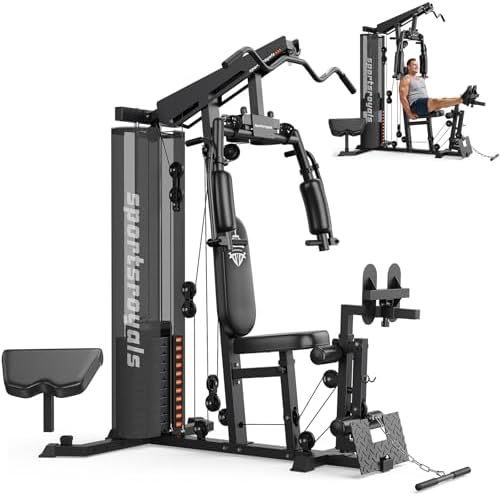
When construction quality matters, Sportsroyals delivers commercial-grade steel framing (70mm x 50mm main base) at a home gym price. With 154 lbs of resistance, precision bearings for whisper-quiet operation, and cables tested to 10,000+ bends, this gym is built to last. Multiple adjustable positions accommodate users of different heights and preferences.
Specifications:
- Weight Stack: 154 lbs selectorized vinyl-coated
- Exercises: 50+ exercises across multiple stations
- Dimensions: 69″ L x 41″ W x 80″ H
- Frame: Commercial-grade steel (70mm x 50mm main base)
- Features: Adjustable backrest, preacher curl pad, butterfly arms
- Cable System: High-tensile steel cables (10,000+ bend tested)
Pros:
- 154 lbs weight stack suitable for most home users
- Commercial-grade steel construction
- Precision-engineered cable pulley system
- 10,000+ bend tests on cables for reliability
- Adjustable butterfly arms for multiple positions
- Three-position adjustable backrest
- Adjustable preacher curl pad
- Thickened cushions for comfort
- Whisper-quiet operation with precision bearings
- Premium paint coating resists corrosion
- Compact size (69″ x 41″ x 80″)
- Multiple exercise stations (chest press, lat pulldown, leg extension, low row)
- Detailed installation instructions with video guidance
- Suitable for families with different fitness levels
- Ships in 4 packages for easier delivery
Cons:
- Relatively new brand (less track record)
- 154 lbs may limit advanced strength athletes
- Assembly can be complex (4-5 hours)
- Ships in 4 separate packages (may arrive on different days)
- Customer service responsiveness varies
- Instructions could be more detailed
- Some users report minor quality control issues
- Limited brand recognition compared to established names
Best For: Home gym enthusiasts seeking commercial-grade construction, quiet operation, and adjustable features at a mid-range price point.
Mikolo Home Gym (150LBS Weight Stack)
Price: $450-$600

Modern multi-station design with smooth operation and thoughtful ergonomic adjustments.
Specifications:
- Weight Stack: 150 lbs selectorized
- Exercises: 30+ exercises across multiple stations
- Stations: High/mid/low pulley, chest press, chest fly, back extension, leg developer
- Dimensions: Approximately 75″ H x 45″ W x 82″ L
- Features: Professional bearing on cable bar, movement guide included
Pros:
- Modern, sleek design aesthetic
- 150 lb weight stack for beginners to intermediate
- A professional bearing system reduces wrist stress
- Readily replaceable/removable preacher curl pad
- Removable leg press accessories
- High, mid, and low pulley system
- Works with multiple handle attachments
- Adapts to various user heights
- Includes movement guide for exercise ideas
- Smooth and quiet operation
- Supersets and dropsets are easily performed
- Good value for the price point
- Responsive customer service (per recent reviews)
Cons:
- Relatively new brand with a limited track record
- Assembly instructions could be more detailed
- 150 lbs is the limit for advanced lifters
- Long-term durability is still being established
- Limited accessories included compared to some competitors
- May require additional attachments for a full workout variety
Best For: Modern home gym enthusiasts seeking sleek design, smooth operation, and good value from an emerging fitness brand.
Fitness Reality Power Cage Squat Rack
Price: $400-$600 (base rack, attachments sold separately)

Heavy-duty power cage system with 800 lb capacity and extensive attachment compatibility.
Specifications:
- Weight Capacity: 800 lbs (ASTM tested at 2,000 lbs)
- Frame: 2″ x 2″ heavy-duty steel tubing
- Dimensions: 53″ W x 51″ D x 82″ H
- Height Adjustments: 16 adjustment holes
- Holes: Standard 1″ sizing for universal attachment compatibility
- Safety: Solid steel safety arms (not hollow tubes)
Pros:
- 800 lb weight capacity (ASTM tested to 2,000 lbs)
- Heavy-duty 2″ x 2″ steel construction
- Solid steel safety arms (30-50% thicker than competitors)
- Multi-grip reversible pull-up bar
- 16 height adjustment positions
- Standard 1″ holes accept universal attachments
- Twin support braces for extreme stability
- Elevated curved brace provides extra workout space
- Compatible with lat pulldown and cable crossover attachments
- Customizable with J-hooks, dip bars, landmine, and weight storage
- Maximum versatility for Olympic lifting, powerlifting, and CrossFit
- Excellent value for weight capacity
- A walk-in design allows easy movement
Cons:
- Base model doesn’t include lat pulldown or cables (sold separately)
- Assembly required (3-4 hours)
- Heavy (difficult to move once assembled)
- Requires Olympic barbell and plates (not included)
- Not a true “multi-station” unless you buy attachments
- Footprint requires a dedicated gym space
- Optional attachments can add $300-$500 to the total cost
Best For: Serious strength athletes who want maximum weight capacity, Olympic lifting capability, and the flexibility to customize their setup with attachments over time.
Understanding Multi-Station Home Gyms
Types of Multi-Station Home Gyms
Stack-Loaded Gyms: Traditional multi-station gyms with selectorized weight stacks (80-210 lbs). Smooth resistance, quick weight changes via pin selection.
Best for: Beginners to intermediate users focused on muscle building and toning.
Power Rod Systems: Flexible resistance rods (like Bowflex) provide resistance of 5-410 lbs. Different feel than free weights, very quiet operation.
Best for: Users who want a space-saving design and joint-friendly resistance.
Bodyweight Systems: Use gravity and incline adjustment (like Total Gym). Resistance from 6-14 levels via incline.
Best for: Functional training, rehabilitation, and low-impact workouts.
Power Rack Systems: Open cage design for free weight training. Requires Olympic barbell and plates.
Best for: Powerlifters, Olympic lifters, and those seeking unlimited resistance.
Hybrid Systems: Combine weight stacks with free weight stations. Offer both machine and free weight benefits.
Best for: Advanced users wanting maximum versatility.
Key Features to Consider
Weight Stack Capacity:
- 80-125 lbs: Entry level, suitable for beginners and toning
- 150-160 lbs: Mid-range, adequate for most home users
- 200+ lbs: Advanced, for experienced lifters
- Consider pulley ratios (some systems multiply base weight)
Number of Exercise Stations:
- 2-3 stations: Basic chest, back, legs
- 4-5 stations: Complete upper and lower body coverage
- 6+ stations: Comprehensive training with specialized movements
- More stations = more variety, but larger footprint
Pulley System:
- High/low pulley: Minimum for versatility
- Mid pulley: Adds ab crunch and triceps options
- No-cable-change: Saves time between exercises
- Quality matters: Look for sealed bearings and smooth operation
Frame Construction:
- 12-14 gauge steel: Commercial-grade durability
- Powder-coated finish: Prevents rust and scratching
- Welded vs. bolted: Welded is stronger but less portable
- Weight capacity: 400+ lbs for stability
Adjustability:
- Seat height and backrest angle
- Press arm positions
- Leg developer settings
- User height accommodation (5’2″ to 6’4″ ideal)
Cable Quality:
- Aircraft-grade steel (military spec)
- Nylon coating: Reduces friction and noise
- 1,000-2,200 lb rating: Ensures safety and longevity
- Self-lubricating: Minimizes maintenance
Comprehensive Buying Guide
Space Requirements
Footprint Considerations:
- Compact: 3′ x 6′ (minimal space gyms)
- Standard: 4′ x 7′ (most home gyms)
- Large: 5′ x 8′ (premium multi-stations)
- Allow 2′ clearance on all sides for safety
Ceiling Height:
- Minimum: 7.5 feet
- Recommended: 8-9 feet
- Power rack pull-ups need: 8+ feet
- Consider basement/garage limitations
Room Integration:
- Dedicated gym room ideal
- Spare bedroom works for compact models
- Garage suitable (consider temperature swings)
- Basement (watch for moisture issues)
Budget Breakdown
Under $500:
- Marcy MWM-990, Marcy MWM-988
- Fitness Reality Power Cage (base)
- BalanceFrom budget models
- 150 lb weight stacks are typical
- Good for beginners and casual users
$500-$1,000:
- Weider 2980 X
- BalanceFrom RS 80
- Mikolo Home Gym
- 150-160 lb weight stacks
- Better construction and features
- Suitable for intermediate users
$1,000-$1,500:
- Total Gym XLS
- Premium BalanceFrom models
- Specialty bodyweight systems
- Excellent build quality
- Advanced features included
$1,500+:
- Bowflex Xtreme 2SE
- Body-Solid G1S
- Commercial-grade equipment
- Lifetime warranties common
- Maximum durability and features
Installation and Assembly
Assembly Time:
- Simple models: 2-3 hours (1 person)
- Standard multi-stations: 3-5 hours (2 people recommended)
- Complex systems: 5-8 hours (2 people minimum)
- Professional assembly: $150-300 (if available)
Tools Needed:
- Allen wrenches (usually included)
- Adjustable wrench
- Socket set
- Level
- Rubber mallet
- Second person highly recommended
Pro Tips:
- Clear and organize all parts before starting
- Follow instructions exactly (don’t skip ahead)
- Don’t fully tighten bolts until the end
- Test all stations before final tightening
- Keep instructions for future maintenance
- Take photos during assembly for reference
Maintenance Requirements
Regular Maintenance (Monthly):
- Inspect cables for fraying or damage
- Check all bolts and connections
- Wipe down upholstery
- Lubricate moving parts if needed
- Test weight stack operation
Quarterly Maintenance:
- Deep clean all surfaces
- Inspect pulleys for wear
- Tighten any loose hardware
- Check seat adjustments
- Verify the safety features function
Annual Maintenance:
- Professional inspection (if possible)
- Replace worn cables
- Update worn upholstery
- Check frame integrity
- Document the condition for warranty
Cable Replacement:
- Signs: Fraying, rust, sticking
- Cost: $20-50 per cable
- DIY or professional: Depends on complexity
- Safety critical: Don’t delay replacement
Safety Considerations
Critical Safety Features:
- Weight stack guards (prevent finger injuries)
- Smooth edges (no sharp metal)
- Stable base (no tipping during use)
- Safety locks on weight selectors
- Proper seat belts/hold-downs where needed
Safe Usage:
- Always warm up before heavy resistance
- Start with lighter weights to test form
- Use safety stops on press arms
- Never exceed the maximum user weight capacity
- Keep the workout area clear of obstacles
- Ensure adequate lighting
- Have a phone nearby for emergencies
Common Mistakes to Avoid:
- Exceeding weight stack capacity
- Jerky or bouncing movements
- Improper seat height adjustments
- Skipping warm-up sets
- Poor form (ego lifting)
- Inadequate rest between workouts
- Ignoring pain signals
Frequently Asked Questions
Q: How much space do I need for a multi-station home gym?
A: Most multi-station gyms require 6′ x 8′ of floor space plus 2′ clearance on all sides, totaling about 10′ x 12′ for comfortable use. Compact models like the Marcy MWM-990 can fit in slightly smaller spaces (8′ x 10′), while larger systems need 12′ x 14′. Ceiling height should be at least 8 feet.
Q: Are multi-station gyms better than free weights?
A: Each has advantages. Multi-station gyms offer safety (no spotter needed), convenience (quick weight changes), space efficiency (one machine for many exercises), and guided motion paths. Free weights provide unlimited resistance, require stabilizer muscles, and allow natural movement patterns. Many serious lifters use both.
Q: How long do multi-station home gyms last?
A: Quality home gyms last 10-20+ years with proper maintenance. Budget models ($300-$600) typically last 5-10 years, mid-range systems ($600-$1,200) last 10-15 years, and premium models ($1,500+) with lifetime warranties can last 20+ years. Cable replacement every 3-5 years is common.
Q: Can I build significant muscle with a 150 lb weight stack?
A: Yes, especially for beginners and intermediate lifters. Pulley systems multiply base weight (150 lbs can provide 300+ lbs resistance on some exercises). Progressive overload, proper form, time under tension, and volume matter more than absolute weight. Advanced lifters may outgrow 150 lbs within 2-3 years.
Q: What’s the difference between weight stacks and Power Rods?
A: Weight stacks provide constant resistance throughout the movement with a familiar free-weight feel. Power Rods (elastic resistance) increase resistance as they bend, providing variable resistance that peaks at full extension. Rods are quieter, more compact, and joint-friendly, but feel different from traditional weights.
Q: How difficult is assembly?
A: Most multi-station gyms take 3-6 hours to assemble with two people. Expect 50-200 parts depending on complexity. Instructions vary in quality (some excellent, others frustrating). Budget 1-2 hours more than the estimated time. Professional assembly costs $150-$300, depending on availability in your area.
Q: Do I need to bolt the gym to the floor?
A: Not usually required for home use if the gym is properly assembled and used within weight limits. However, bolting provides maximum stability, especially for power racks, systems over 300 lbs, or if used by multiple heavy users. Check manufacturer recommendations.
Q: Can multiple people use a multi-station gym simultaneously?
A: Most home gyms are designed for one user at a time, though some larger models have independent stations (like Body-Solid EXM systems) allowing 2-3 simultaneous users. For home use, a single-user is typical and safer.
Q: What maintenance is required?
A: Minimal maintenance needed. Monthly: Wipe down upholstery, check cables for fraying, tighten loose bolts. Quarterly: Deep clean, lubricate moving parts. Annually: Professional inspection, replace worn cables. Most home gyms require 10-15 minutes of monthly maintenance.
Q: Are budget home gyms worth it?
A: Yes, if expectations match price. Budget gyms ($300-$600) work well for beginners, casual exercisers, and those new to strength training. They offer 80% of the functionality at 30% of the cost. Expect a shorter lifespan (5-10 years vs. 15-20+) and basic features, but it is adequate for most home users.
Q: Can I add weight to a weight stack gym?
A: Some models allow weight stack upgrades (Body-Solid offers premium plate upgrades), but many do not. Check manufacturer specifications. Power rod systems (such as Bowflex) can usually be upgraded with additional rod sets. For unlimited weight, consider power rack systems with Olympic plates.
Q: What’s better for beginners: a multi-station gym or free weights?
A: Multi-station gyms are often better for beginners because they provide guided motion paths, don’t require spotters, allow quick resistance changes, and reduce injury risk from dropping weights. Once proper form is mastered (6-12 months), adding free weights increases versatility.
Q: How do I know if a home gym will fit through my door?
A: Most home gyms ship in pieces and assemble in the room. Check the dimensions of the largest single piece in the product specifications. Standard doors are 32-36″ wide. Basement stairs are the main concern. Measure stairway width, turns, and ceiling clearance before ordering.
Q: What exercises can’t I do on a multi-station gym?
A: Most lack: deadlift capability (power racks solve this), Olympic lifts (requires free weights), barbell squats (some have leg press instead), and heavy compound movements requiring a spotter. Multi-stations excel at isolated exercises (lat pulldowns, leg extensions, chest press) but are limited for powerlifting-style training.
Q: Should I buy new or used?
A: New is recommended unless buying from a trusted source. Used gyms save 40-60% but may have worn cables, damaged upholstery, missing parts, and no warranty. If buying used, thoroughly inspect the cables, pulleys, weight-stack operation, and frame integrity. Ask about age and usage frequency.
Affiliate Disclosure: Stem & Stone earns from qualifying purchases. Our recommendations are based on research and user feedback, not affiliate relationships.
Leave a Reply